
Recipe2 min read
The morning kahwa
Cardamom, cinnamon, a thread of saffron. The cup that starts a Srinagar day.
From the unit at Ganderbal
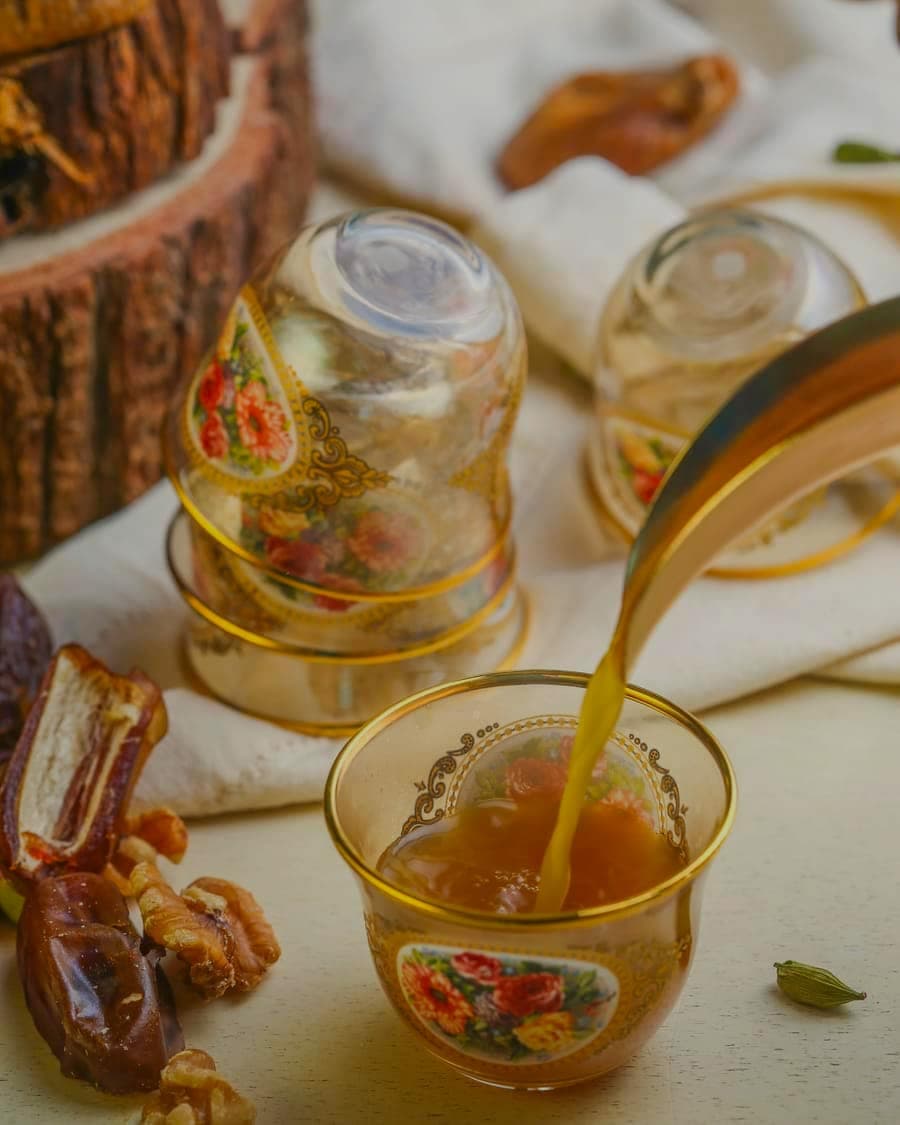
Kahwa is not a drink you have instead of tea. It is what happens in a Kashmiri house all day: after a meal, when a guest arrives, in the middle of an afternoon that has gone cold, and first thing in the morning before anyone has said much.
What is actually in it
A kahwa blend is green tea leaves with whole spices — cardamom and cinnamon at the least, sometimes a clove or two, sometimes a dried rose petal. Then saffron and almonds go in at the point of making.
There is no milk. There is usually sugar, and often more of it than a visitor expects. Nobody in Srinagar apologises for that.
The two rules
Do not boil the leaves. Green tea gives up its tannins fast under a hard boil, and tannin is bitterness. Boil the water and the whole spices as much as you like — then take the pan off the flame before the leaves go in, and let them sit for three or four minutes. Any longer and you can taste it.
Add the saffron at the end. Saffron's aroma lives in volatile compounds that leave with the steam. Soak the threads in a little hot water while everything else happens, and stir that in off the heat. You will get the smell as well as the colour, and the smell is most of what saffron is.
About the saffron
Real Kashmiri saffron is grown on the Pampore karewas, an hour from our unit, and it is expensive for the honest reason that it is picked by hand, three threads at a time, for a few weeks in autumn.
A pinch is a pinch — ten or twelve threads for four cups. More is not better; past a point it turns medicinal.
If your saffron is bright red and smells of hay and honey, it is good. If it is uniformly orange, smells faintly of nothing, and colours water instantly and violently, it is very likely dyed something else.
The samovar
Traditionally kahwa is made in a copper samovar with a chimney of live coals down the middle, so the pot never stops being hot and the kahwa is poured all afternoon.
You do not need one. But if you ever get the chance to drink from one — in a shop in the old city, at a wedding, in somebody's front room — take it. The tea is the same and the afternoon is not.
The recipe
Makes 4 small cups · 5 min prep · 10 min cooking
What you need
- 4 cupswater
- 2 tspKashmiri kahwa blend
- 4green cardamom pods, lightly crushed
- 1small piece of cinnamon bark
- a good pinchKashmiri saffron
- 8 to 10almonds, blanched and slivered
- to tastesugar or honey
What you do
Step 1. Put the saffron in a tablespoon of hot — not boiling — water and leave it while you do everything else. Ten minutes turns a pinch of threads into a proper colour and smell.
Step 2. Bring the water to the boil with the cardamom and cinnamon. Let it boil for two or three minutes so the whole spices open.
Step 3. Take the pan off the heat, then add the kahwa blend. Green tea leaves boiled hard turn bitter; off the heat they infuse without turning.
Step 4. Cover and leave it for three to four minutes. No longer.
Step 5. Stir in the saffron with its soaking water, and sweeten to taste. Kashmiris tend to take it sweeter than outsiders expect.
Step 6. Pour through a strainer into small cups, and drop the slivered almonds in at the last moment so they are still crunching when the cup arrives.
Worth knowing
- Never boil the tea leaves. Everything else may boil; the leaves may not.
- Add the saffron at the end, off the heat. Boiling saffron drives off the aroma you paid for and leaves only the colour.
- Traditionally this is made in a samovar, with coals in the central chimney. A pan is fine — the sequence is what matters, not the vessel.